Put a laundry pod into the washing machine, add your clothes, and you are ready to go. There is no liquid to pour or dose to measure. The convenience is easy to understand.
But where does the thin film around the detergent go after the wash?
It usually dissolves during washing. The next question is what happens after that.
This brings us to PVA, short for polyvinyl alcohol and also written as PVOH. It is a synthetic polymer commonly used to make the water-soluble film around laundry pods.
Blueland, a US cleaning brand, has repeatedly criticised PVA-containing pods and laundry sheets, linking them to plastic pollution and supporting proposals to restrict their sale. Meanwhile, companies including Procter & Gamble continue to offer laundry products that use the material.
Both sides talk about the environment, and both point to research. What should we make of it?
We looked at publicly available product information and read papers often cited in the debate. To understand the issue, it helps to start with the film itself.
When the film dissolves, the story is not over
PVA can be made into a water-soluble film that holds detergent. There is a material basis for describing this film as a water-soluble plastic. Tide also identifies PVA in its official explanation of laundry pod film.
Yet the word plastic often brings to mind fragments floating in water. Dissolved PVA can instead be dispersed as individual polymer chains. We cannot simply treat those dissolved chains as solid microplastic particles.
EU legislation also makes this distinction, excluding polymers that meet specified solubility conditions from its definition of synthetic polymer microparticles. That classification does not, by itself, tell us everything about their environmental effects.
A film becoming invisible only tells us that we can no longer see it. Whether microorganisms can then break down its molecules requires different evidence.
This is where much of the debate begins.
A 2024 study used a particular detergent-grade PVA in a laboratory simulation of domestic wastewater treatment. Once the system had been running and reached a stable phase, removal of dissolved organic carbon was high. Together with other experiments, the results led the researchers to attribute most of that removal to biodegradation.
A seawater experiment gave a different result. In a 2021 study, several PVA-based materials showed slow biodegradation over 28 days under the particular marine test conditions.
These findings do not necessarily contradict each other. The materials were not identical, and neither were the microorganisms or treatment conditions. Results from a wastewater treatment system cannot simply be transferred to the ocean.
A 2026 study examined particular laundry pod films and gel-like residues left after washing. Under the dilution conditions tested, the residues could disperse again. Within the detection limits of the methods used, the researchers found no PVA microplastic- or nanoplastic-like particles.
That helps explain the physical form of some residues. It did not directly test their subsequent biodegradation, and it cannot establish the long-term environmental safety of every PVA-containing product.
So asking whether PVA biodegrades is only a starting point. We also need to ask: which PVA, in what environment, and over how much time?
The available research does not support a blanket claim that PVA-containing laundry products cause major environmental harm. Nor does it justify promising that they are completely harmless in every environment.
Why does PVA also appear in laundry sheets and newer detergent formats?
PVA is not used only as an outer film.
Some laundry sheets use it to bind cleaning ingredients into a sheet that you can pick up. Earth Breeze has disclosed this role in its official information. A sheet can therefore contain PVA even when there is no separate wrapper to see.
Other newer laundry formats use it too.
Tide evo, from Procter & Gamble, is a fibre-based laundry tile rather than a conventional liquid pod. Its cleaning ingredients are held in a dry fibre structure, with each tile providing a ready-to-use portion. The official ingredient list for the corresponding product still includes a polyvinyl alcohol polymer to support the structure and help stabilise the formulation.
Kao’s Attack ZERO Perfect Stick puts powder into a stick-shaped format. It removes the need to measure out loose powder, but it still has a water-soluble outer film. The film’s specific material needs to be checked against the product information; its appearance alone is not enough.
The differences between pods, laundry sheets, fibre tiles and powder sticks go well beyond their shape.
PVA may hold detergent inside a film or help the product keep its form. Making a detergent dry, thin or small does not necessarily mean it no longer uses PVA.
Equally, containing PVA does not mean that an entire laundry sheet or detergent tile is made of PVA. For a particular product, the ingredient list remains the place to start.
How should we assess Blueland’s criticism?
One point Blueland raises is worth keeping: dissolving in water is not the same as disappearing from the environment.
Its continued focus on the issue also needs to be considered in its business context.
Blueland sells PVA-free laundry tablets. Consumers concerned about PVA in pods and sheets may be more likely to consider that alternative. The brand takes part in environmental advocacy while competing in the same market.
It is reasonable to recognise that commercial interest. But a commercial interest does not make the question worthless. What matters is how far the evidence supports the claims.
Take the often-repeated figure of around 77% of PVA entering the environment. It comes from an emissions model, not a nationwide field survey measuring PVA at wastewater treatment plants. The model also separates the sludge and treated-effluent routes. It should not be rewritten as “77% flows straight into rivers and seas.” Blueland provided part of the funding for that study.
On the other side, the authors of the 2024 wastewater treatment study worked for Procter & Gamble. The 2026 pod film analysis was also funded by Procter & Gamble.
Funding relationships should be disclosed. The research still needs to be assessed on its methods, results and scope. We should not skip that step because one brand’s position happens to appeal to us.
The same care is needed when discussing legislation.
New York City did introduce proposal Int.0035-2024 in 2024, seeking to prohibit the sale of relevant PVA-containing laundry and dishwasher pods and sheets. The original proposal was archived when the legislative session ended in late 2025 and did not become law.
A brand supporting a proposed ban is not the same as those products already being prohibited by law.
Can laundry still be convenient without this film?
Yes. Pods remove the need to measure detergent, but a water-soluble film is not the only way to do that.
Blueland’s own laundry tablets are one example. They are hard tablets, not flexible laundry sheets. According to the brand’s public information, they do not use PVA or need an individual water-soluble film around each tablet. You can still take out a ready-made portion.
Vove also offers unwrapped, PVA-free laundry tablets. Its ingredient list includes PEG, or polyethylene glycol, as a binding ingredient. Replacing PVA does not remove the need to understand the replacement material; we need to look beyond the ingredient that has been left out.
There is also a more familiar option: loose laundry powder and a measuring scoop.
Meliora uses this approach, with a reusable scoop and refill packaging rather than a separate water-soluble film around every portion. You can adjust the amount to the laundry load and the product directions.
Of course, the scoop needs to be comfortable to hold, its markings need to be clear, and the packaging needs to keep moisture out. Unwrapped tablets have their own practical challenges, including moisture, breakage and dissolution.
A change of material does not make those design details disappear.
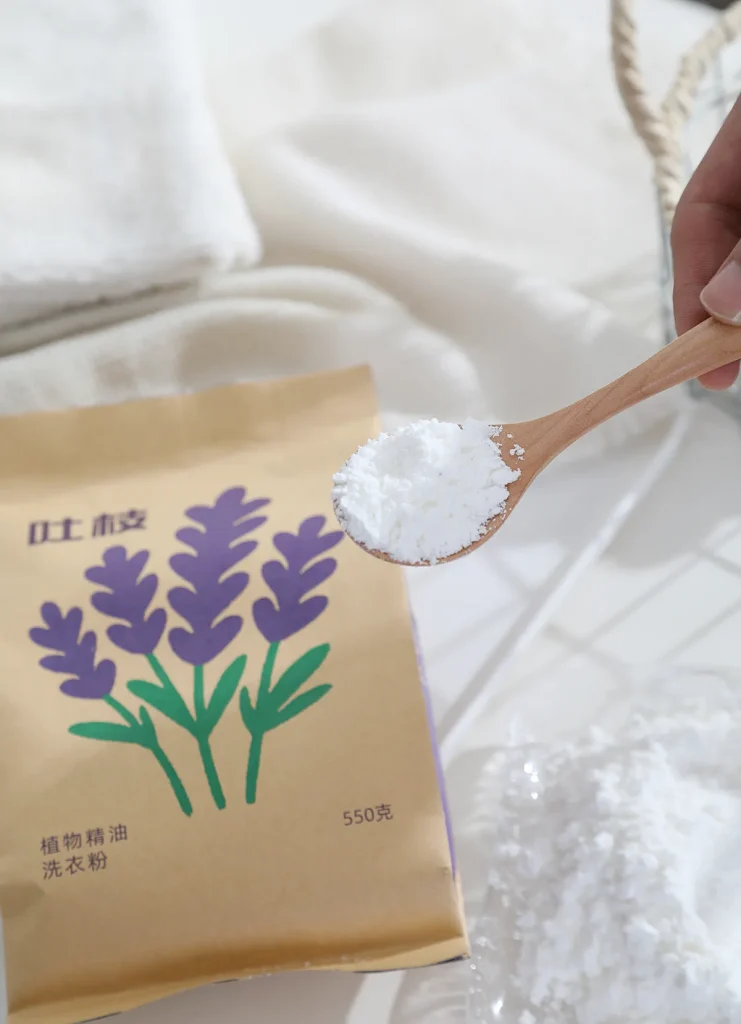
We include a scoop with our Twiggy laundry powder to give you a useful reference. One level scoop holds approximately 10–15 g; adjust the amount to the load and follow the product directions. Convenience can come from a pre-measured portion or from a scoop that is easy to use.
Laundry pods offer real convenience, and the questions about PVA deserve continued research. When considering a product, it is worth looking at both how it makes laundry easier and what evidence the brand provides about its materials and environmental effects.
At Twiggy, we will continue to look into these questions too. A convenient wash can begin with a pre-measured portion—or with a well-designed measuring scoop.
Sources and further reading
We prepared this article using publicly available brand information, research papers and regulatory documents. Sources were checked through 12 October 2026.
Product information:
- Tide: PVA film in laundry pods; Tide evo product information; ingredient list for the corresponding Tide evo product.
- Kao: Attack ZERO Perfect Stick product information.
- Earth Breeze: laundry sheets and PVA.
- Blueland: its position on pods and laundry sheets; Blueland laundry tablet information.
- Vove: laundry tablets and ingredients; Meliora: laundry powder and dosing.
Regulatory documents:
- Commission Regulation (EU) 2023/2055.
- New York City proposal Int.0035-2024 and its legislative status.
Key studies:
- Rolsky and Kelkar, 2021. PVA wastewater treatment and emissions modelling. DOI: 10.3390/ijerph18116027.
- Alonso-López et al., 2021. Biodegradation and toxicity of PVA-based materials in seawater. DOI: 10.3390/polym13213742.
- McDonough et al., 2024. A laboratory simulation of PVA removal during wastewater treatment. DOI: 10.1002/ieam.4929.
- Agostiniano et al., 2026. Analysis of PVA detergent films and washing residues. DOI: 10.1021/acsapm.6c02957.
Further reading: Understanding detergent ingredients · More from our cleaning journal